
You Don't Need to Be an Artist to Heal Through Art

A gentle introduction to art therapy for complete beginners
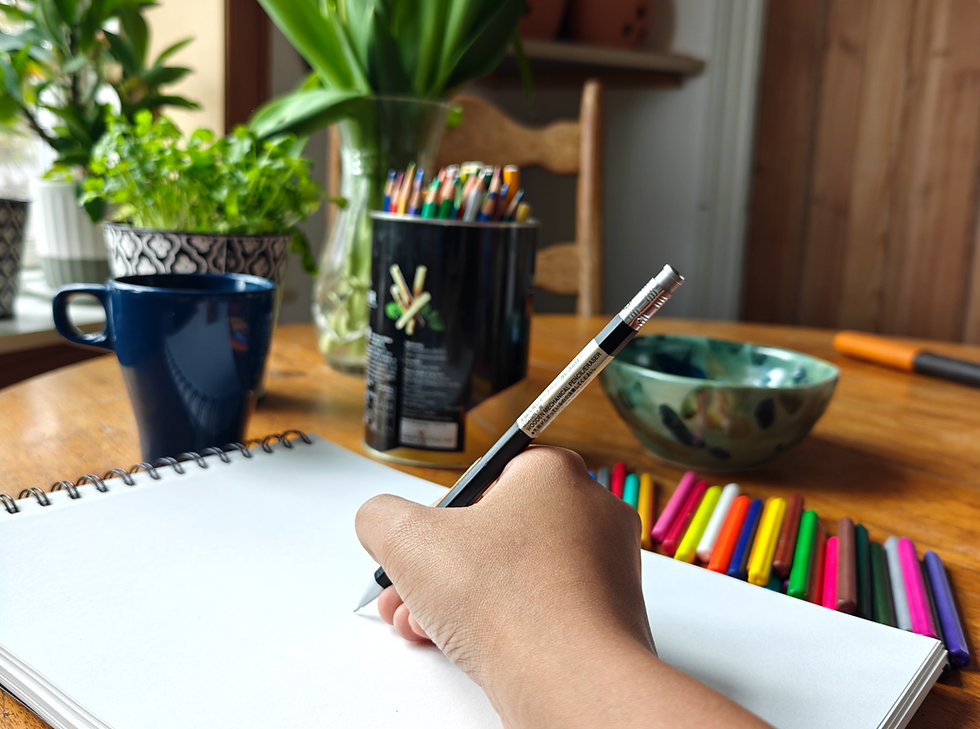
Let's start with the thing most people say when they hear 'art therapy': "But I can't draw."
That's fine. Actually, that might even help. Art therapy is not about making something beautiful. It is not about talent, technique, or producing anything that belongs on a wall. It is about the act of making - and what that act quietly does to you while it's happening.
"Often the hands will solve a mystery that the intellect has struggled with in vain."
— Carl Jung
Jung said this long before art therapy was a formal practice. But he understood something essential: the mind and the body are in constant conversation, and sometimes the hands know what the words don't.
So what actually happens in art therapy?
In a session, you might be given a piece of paper and some basic materials - pencils, pastels, torn magazine pages, leaves from outside. You might be asked a simple prompt: draw how your week felt. Or: make something that represents where you are right now.
There's no evaluation. No one grades your drawing. The artwork is simply a starting point - a way of getting something out of your head and onto the page, where you and your therapist can look at it together.

Often, what appears on the page surprises people. You might draw something darker than you expected. Or lighter. You might find yourself using a colour you didn't consciously choose, or drawing a shape that, once you see it, makes complete sense.
Why art works when words don't
Talking about difficult emotions requires a particular kind of readiness. You need to find the right words, form them into sentences, and speak them out loud to another person. That's a lot to ask - especially when what you're feeling is confusing, raw, or has no name yet.
Art bypasses that requirement entirely. You don't need to explain it. You just make it. The drawing, the collage, the stitched line - these carry the meaning before you've had to translate it into language.
"The creative act is not performed by the artist alone; the spectator brings the work in contact with the external world."
— Marcel Duchamp
What art therapy is not
It is not art class. There is no right way to complete the activity. It is not a test of creativity or imagination. And it is not something that only works for people who are 'expressive' by nature.
Some of the most quietly transformative sessions happen with people who insist they have no artistic ability at all - and who, thirty minutes into tearing coloured paper into shapes, realise they haven't thought about their anxiety for the past half hour.
Try this before your next session (or right now): 1. Find a blank piece of paper and any mark-making tool - a pen, a pencil, a crayon. 2. Set a timer for five minutes. 3. Draw how your day felt. Not what happened. How it felt. Shapes, lines, colours - whatever comes. 4. When the timer stops, look at what you made. Notice what's there without judging it. 5. Ask yourself: if this drawing could speak, what would it say? |


Comments